


A healthy total sales figure does not tell a Moroccan rental agency which cars are working, which ones spend most of the month parked, or how much of the invoiced money has actually been collected. One busy vehicle can hide another that was rented for only a few days, just as several unpaid balances can hide behind an encouraging month of invoices.
This guide focuses on three groups of indicators available in LocaFlotte reports: rented days and occupancy, revenue by vehicle, and the relationship between invoiced, collected and outstanding amounts. They provide a practical view of the revenue side of the business. Each indicator answers a different question, and each has limits that matter before the agency changes prices, renews a category or follows up a customer.
Revenue is not the same as profit
Revenue measures what the agency bills. Profit also depends on purchase or leasing costs, insurance, repairs, financing, taxes and periods when a car cannot be rented. LocaFlotte does not contain every one of those costs, so its reports should not be presented as a complete profit-and-loss calculation. They measure activity and revenue accurately, giving the manager a solid starting point to combine with accounting and cost records.
Indicator 1: rented days and occupancy
What it measures
For a selected period, the report counts the days vehicles were rented and relates them to the available days in the fleet. An occupancy rate of 50% means that, on average, the relevant vehicles were rented one day out of two. The top-vehicles view also shows rented days for each car, making a fleet-wide percentage easier to investigate.
How to read it
Compare like with like: July with another high-season month, or this low season with the same period last year. Forty percent may be acceptable in a quiet period and disappointing in August. A car with very few rented days may belong to a category with weak local demand, carry an unsuitable price, or have spent part of the month unavailable. The schedule and vehicle history provide the context.
Its limits
High occupancy is not automatically good. A vehicle can be busy because its price is too low, while a fleet at almost full occupancy may be turning customers away. Occupancy describes use, not the value earned from that use, so it needs to be read next to vehicle revenue.
Indicator 2: revenue by vehicle
What it measures
The top-vehicles report lists the revenue generated by each vehicle during the chosen period together with its rented days. This reveals which cars contribute most to sales instead of leaving all performance hidden inside one agency total. Comparing revenue with rented days also gives the manager a simple reading of revenue per rented day, without claiming that it is net profit.
How to read it
Look for combinations rather than one ranking. High revenue with many rented days may confirm strong demand. Low revenue with very few days calls for questions about price, category, visibility or downtime. A premium car can earn more than a small car while being rented less often, so neither days nor revenue should be judged alone.
Its limits
Vehicle revenue is the income side only. The reports do not calculate the complete cost per kilometre or return on investment because repair, financing and every operating cost are not recorded there. Before selling or buying a vehicle, combine its revenue and activity history with garage invoices, insurance, financing information and its market value.
Indicator 3: invoiced, collected and outstanding amounts
What it measures
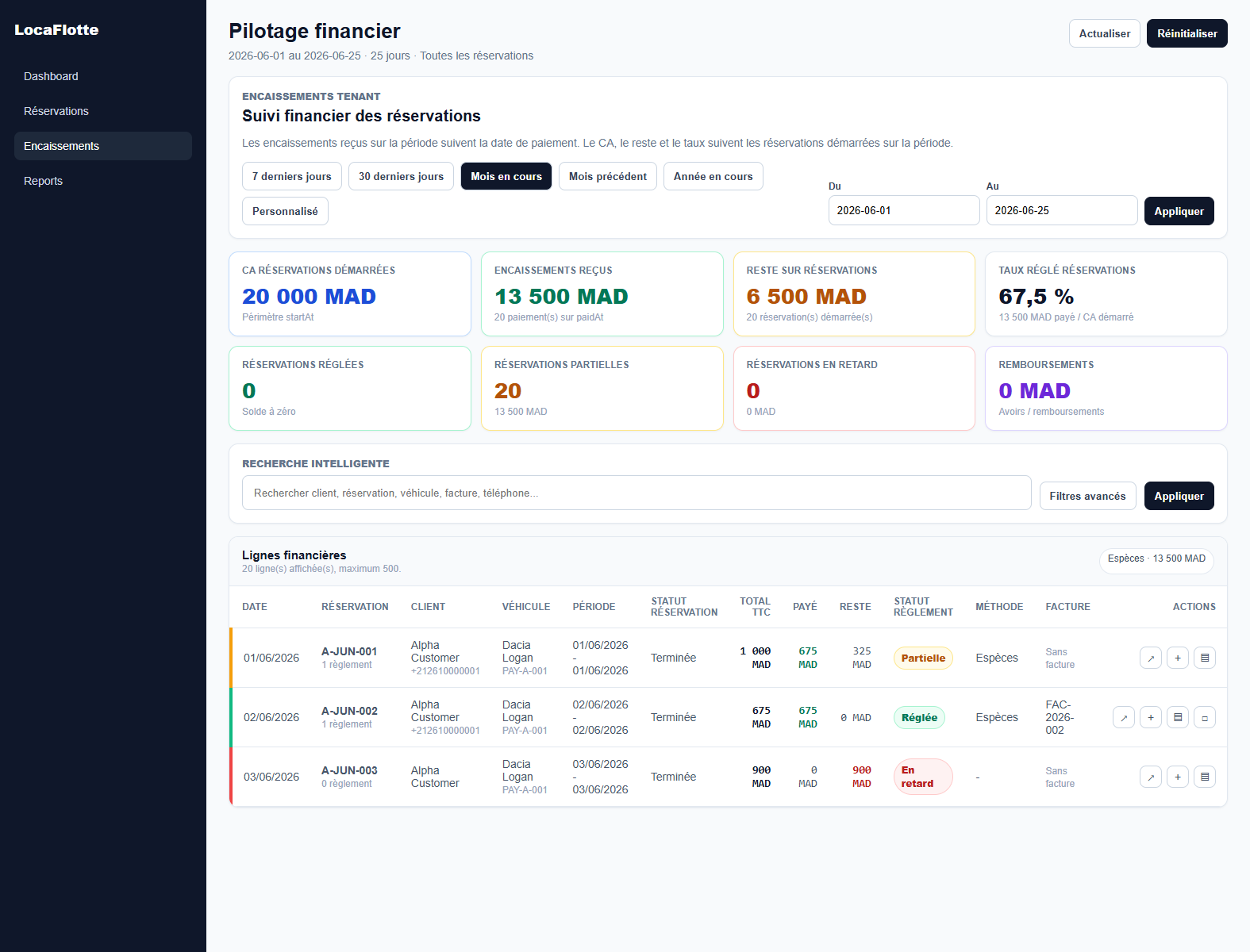
Issuing an invoice is not the same as receiving the money. LocaFlotte reports separate the amount invoiced during the period, the amount collected and the remaining balance, with overdue invoices available for follow-up. Payments recorded on reservations, including deposits and partial payments, feed this view as the team works.
How to read it
The outstanding amount is an immediate cash-control signal. Review it every week and use the top-customers report to identify customers associated with significant activity or open balances. An agency that invoices slightly less but collects reliably may have stronger cash flow than one that announces higher sales and spends months chasing payment.
Its limits
A growing balance does not explain its own cause. It may reflect payment terms agreed with a business customer, a missed follow-up or a disputed invoice. The report points to the records that need attention; the agency still has to check the reservation, payment entries and commercial context before acting.
Where these figures appear in LocaFlotte
The administration reports bring together invoiced sales, collected amounts, balances and delays for the selected period, as well as rented days, occupancy, top vehicles, top customers and month-by-month activity. Reservations and invoices can be exported as CSV files for further analysis or for the accountant. Fleet deadline alerts cover operational dates such as insurance, road tax, technical inspection and oil changes; they provide context but are not a calculation of vehicle profit.
Also read:Financial management with LocaWalletRental fleet management
Fictional example: two cars, two different stories
This example is deliberately simplified and entirely fictional. Over a 30-day month, a city car is rented for 24 days and produces MAD 6,000 in revenue: 80% occupancy. An SUV is rented for 6 days and produces MAD 3,600: 20% occupancy. The agency total of MAD 9,600 looks respectable, but the vehicle view raises useful questions about the SUV. Is the local demand weak, is the price unsuitable, or was it unavailable? If MAD 2,000 linked to its rentals also remains unpaid at month-end, the collection report highlights another issue. The numbers do not give the final answer; they tell the manager exactly where to investigate.
A simple monthly review routine
Choose one consistent period and start with fleet occupancy. Open the top-vehicles report to identify the cars behind the average, then compare their rented days and revenue. Review invoiced, collected and outstanding amounts and assign follow-up for overdue balances. Finally, export the useful data if it needs to be combined with accounting costs. A short monthly review using the same order is more useful than a large analysis performed once a year.
Also read:Departure and return scheduleHow to monitor a rental fleet every day
Questions to ask before making a decision
A weak month does not automatically justify lowering a price or selling a car. Check whether the periods are comparable, whether a vehicle was unavailable, whether a special discount affected revenue, and whether payments were simply recorded later. Reports make differences visible, but management judgement supplies the explanation. For an investment decision, add the costs that sit outside LocaFlotte and test more than one scenario.
Frequently asked questions
How is fleet occupancy read?
Rented days over the selected period are compared with available fleet days. The top-vehicles report adds the detail for each car, including its rented days and revenue.
Does LocaFlotte calculate cost per kilometre or vehicle ROI?
No. It measures revenue, rented days and collections and keeps operational vehicle history, but it does not contain every repair, financing and ownership cost required for those calculations.
What is the difference between invoiced, collected and outstanding?
Invoiced is the value billed, collected is the amount actually received, and outstanding is the unpaid balance. Payment entries recorded during the rental feed those figures.
What do the top-vehicles and top-customers reports show?
Top vehicles compare revenue and rented days by car. Top customers help the agency review the customers associated with the most activity and support follow-up on open balances.
Can the data be exported for an accountant?
Yes. Reservation and invoice data can be exported in CSV format for further analysis or reconciliation with accounting and cost records.
Can one indicator prove that a car is profitable?
No. Occupancy, revenue and collections describe important parts of performance, but complete profitability also requires costs that are managed outside these reports.
In summary, good fleet management starts by separating three questions: are the vehicles being rented, how much revenue does each one generate, and is the invoiced money being collected? LocaFlotte reports make those questions measurable. Combined with the agency's own cost records and local knowledge, they support decisions grounded in evidence rather than a single headline sales figure.
Also read:Track receipts and expenses with LocaWalletOrganize your rental schedule
Manage your fleet with real activity figures
Discover LocaFlotte reports for occupancy, vehicle revenue, collections and outstanding balances.
Request a demo